



Sodium Channel
Na channels; Na+ channels
Sodium channels are integral membrane proteins that form ion channels, conducting sodium ions (Na+) through a cell's plasma membrane. They are classified according to the trigger that opens the channel for such ions, i.e. either a voltage-change (Voltage-gated, voltage-sensitive, or voltage-dependent sodium channel also called VGSCs or Nav channel) or a binding of a substance (a ligand) to the channel (ligand-gated sodium channels). In excitable cells such as neurons, myocytes, and certain types of glia, sodium channels are responsible for the rising phase of action potentials. Voltage-gated Na+ channels can exist in any of three distinct states: deactivated (closed), activated (open), or inactivated (closed). Ligand-gated sodium channels are activated by binding of a ligand instead of a change in membrane potential.
Sodium Channel Isoform Specific Products
-
Sodium Channel
(629)
View all products
-
Nav1.1
(11)
View all products
-
Nav1.2
(16)
View all products
-
Nav1.3
(14)
View all products
-
Nav1.4
(14)
View all products
-
Nav1.5
(21)
View all products
-
Nav1.6
(12)
View all products
-
Nav1.7
(62)
View all products
-
Nav1.8
(41)
View all products
-
Nav1.9
(2)
View all products
All Product Categories
-
Sodium Channel Inhibitors
(620)
View all products
-
Sodium Channel Agonists
(10)
View all products
-
Sodium Channel Antagonists
(30)
View all products
-
Sodium Channel Activators
(35)
View all products
-
Sodium Channel Modulators
(30)
View all products
-
Sodium Channel Controls
(5)
View all products
-
Sodium Channel Ligands
(3)
View all products
-
Sodium Channel Related Products (803)
Related Products (803)

-
Antibodies (9)
-
Related Compound Screening Libraries (1)
-
Sodium Channel Isoform Comparison
-
Pramocaine hydrochloride (Standard)
 0 ImagesPramocaine (Pramoxine) hydrochloride (Standard) is the analytical standard of Pramocaine hydrochloride (HY-B1319). This product is intended for research and analytical applications. Pramocaine hydrochloride is a topical surface anesthetic and antipruritic agent. Pramocaine hydrochloride reversibly inhibits voltage-gated sodium channel, reduces transmembrane permeability of sodium ions, stabilizes cell membranes, prevents depolarization, blocks action potential conduction, and inhibits peripheral slow C-fiber pathways associated with pain, pruritus and thermoception. Pramocaine hydrochloride can be used in research related to chronic pruritus, renal pruritus, atopic dermatitis, xerotic pruritus, uremic pruritus, and cutaneous hyperalgesia/pain.
-
TC-N 1752-d5
 0 ImagesCat. No.: HY-107405S
-
Aprindine hydrochloride (Standard)
 0 ImagesCat. No.: HY-A0236ARCAS No.: 33237-74-0Aprindine hydrochloride (Standard) is the analytical reference standard of Aprindine hydrochloride (HY-A0236A). This product is used for research and analytical applications. Aprindine hydrochloride is an Ib-class anti-arrhythmic agent. Aprindine hydrochloride mainly exerts its effect by blocking sodium channels (INa), thereby reducing the excitability and conduction velocity of cardiac muscle cells. Aprindine hydrochloride significantly inhibits delayed potassium currents, which helps to prolong the atrial effective refractory period (AERP) and inhibit the occurrence of atrial fibrillation. Aprindine hydrochloride can also regulate intracellular calcium ion concentration by inhibiting Na+/Ca2+ exchange current (INCX), thereby further stabilizing cardiac electrical activity. Aprindine hydrochloride can be used for the study of atrial fibrillation (AF) and ventricular arrhythmias.
-
Licarbazepine-d8
 0 ImagesCat. No.: HY-108506S4CAS No.: 1261393-17-2Synonyms: BIA 2-005-d8; GP 47779-d8Licarbazepine-d8 (BIA 2-005-d8) is deuterium labeled Licarbazepine. Licarbazepine (BIA 2-005; GP 47779)?is a?voltage-gated sodium channel?blocker?with?anticonvulsant?and?mood-stabilizing?effects.
-
LY393615 free base
 0 ImagesCat. No.: HY-135478ACAS No.: 774528-12-0Synonyms: NCC1048 free baseLY393615 (NCC1048) free base is a novel neuronal Ca2+ (calcium channel) and Na + channel (sodium channel) blocker with IC50s of 1.9 μΜ and 5.2 μΜ for α1A and α1B calcium channel subunits. LY393615 free base has good brain penetration and neuroprotective effects in models of in cerebral ischemia that can be used for neurological disease research.
-
A-887826 (Standard)
 0 ImagesCat. No.: HY-100080RCAS No.: 1266212-81-0A-887826 (Standard) is the analytical standard of A-887826 (HY-100080). This product is intended for research and analytical applications. A-887826 is a potent, selective, oral bioavailable and voltage-dependent Na(v)1.8 sodium channel blocker with an IC50 of 11 nM . A-887826 attenuates neuropathic tactile allodynia in vivo.
-
Flunarizine (Standard)
 0 ImagesFlunarizine (Standard) is the analytical standard of Flunarizine. This product is intended for research and analytical applications. Flunarizine is a potent dual Na+/Ca2+ channel (T-type) blocker. Flunarizine is a D2 dopamine receptor antagonist. Flunarizine shows anticonvulsive and antimigraine activity, and peripheral vasodilator effects.
-
Atelopidtoxin
 0 ImagesAtelopidtoxin (zetekitoxin) is a toxin (LD50=0.016 mg/kg for mice), which can be isolated from Panamanian frog Atelopus zeteki. Atelopidtoxin causes hypotension and ventricular fibrillation in rabbits. Atelopidtoxin an inhibitor for sodium channel.
-
Propafenone-d5 Ethyl hydrochloride
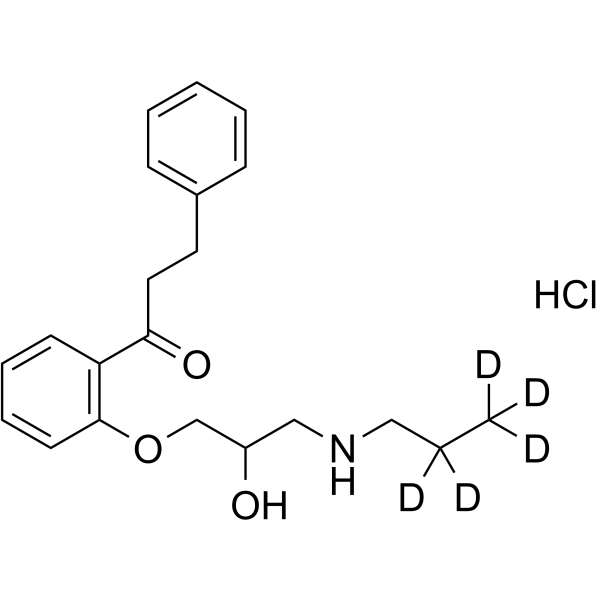 0 ImagesCat. No.: HY-B0432AS3CAS No.: 1398066-02-8Propafenone-d5 Ethyl (hydrochloride) is the deuterium labeled Propafenone hydrochloride. Propafenone (SA-79)hydrochloride is a class of anti-arrhythmic medication, which treats illnesses associated with rapid heart beats such as atrial and ventricular arrhythmias.
-
Nerispirdine
 0 ImagesCat. No.: HY-106017CAS No.: 119229-65-1Nerispirdine is an ion channel inhibitor with IC50s of 3.6, 3.7 and 11.9 μM against K(v)1.1, K(v)1.2 and voltage-dependent Na(+) channel, respectively. Nerispirdine is a 4-aminopyridine (4-AP, HY-B0604) derivative and can be utilized in research on neurological disorders.
-
Methocarbamol-d3
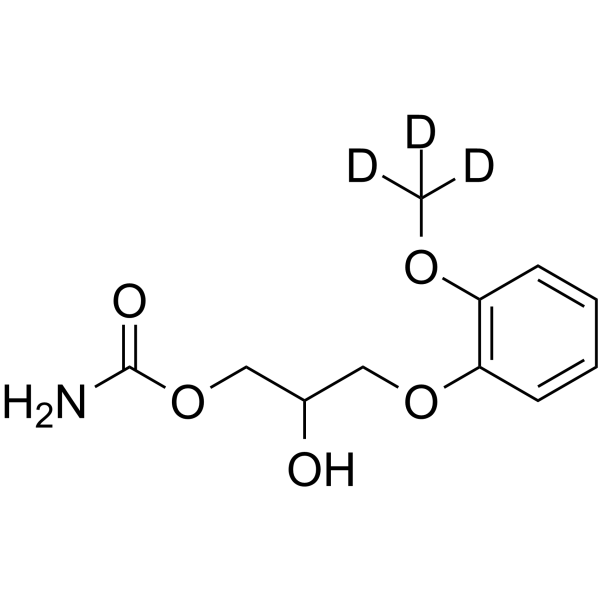 0 ImagesMethocarbamol-d3 is the deuterium labeled Methocarbamol. Methocarbamol is an orally active central muscle relaxant and blocks muscular Nav1.4 channel. Methocarbamol reversibly affects voltage dependence of inactivation of Nav1.4 channel. Methocarbamol has the potential for muscle spasms and pain syndromes research.
-
QX-222 chloride (Standard)
 0 ImagesCat. No.: HY-101362RCAS No.: 5369-00-6QX-222 (chloride) (Standard) is the analytical standard of QX-222 (chloride) (HY-101362). This product is intended for research and analytical applications. QX-222 chloride, a trimethyl analogue of Lignocaine (HY-B0185), is a potent Na+ channel blocker.
-
Sulcardine hydrochloride
 0 ImagesCat. No.: HY-156976ACAS No.: 343935-48-8Sulcardine hydrochloride is a multi-ion channel blocker that can reduce INa and ICa with IC50 values of 26.9 µM and 69.2 µM, respectively. Sulcardine hydrochloride is a potent hNav1.5 channel blocker with a mild inhibitory effect on hERG channels. Sulcardine hydrochloride has anti-arrhythmic effects.
-
Suzetrigine N-oxide
 0 ImagesSuzetrigine N-oxide (the third compound in P57) is a derivative of Suzetrigine (HY-148800). Suzetrigine N-oxide is an inhibitor of voltage-gated sodium channels (Nav1.8) and can be used for research on the treatment of pain, especially neuropathic pain.
-
Topiramate-13C6-1
 0 ImagesCat. No.: HY-B0122SS1Synonyms: McN 4853-13C6-1; RWJ 17021-13C6-1
-
Atomoxetine-d7
 0 ImagesCat. No.: HY-107370SCAS No.: 919104-07-7Synonyms: Tomoxetine-d7; (R)-Tomoxetine-d7Atomoxetine-d7 (Tomoxetine-d7) is deuterium labeled Atomoxetine. Atomoxetine (Tomoxetine) is a selective noradrenaline reuptake inhibitor with Ki values of 5, 77 and 1451 nM for norepinephrine (NE), serotonin (5-HT) and dopamine (DA) transporters, respectively. Atomoxetine (Tomoxetine) increases of DAEX and NEEX in the PFC and enhances catecholaminergic neurotransmission. Atomoxetine (Tomoxetine) is a potent Na+ channels (VGSCs) blocker. Atomoxetine (Tomoxetine) can be used for attention-deficit hyperactivity disorder (ADHD) research.
-
GNE-3565
 0 ImagesCat. No.: HY-185334CAS No.: 2222537-72-4GNE-3565 is an arylsulfonamide class NaV1.7 inhibitor with subnanomolar channel blockage and mixed subtype selectivity.GNE-3565 can be used for the research of pain.
-
Metergoline (Standard)
 0 ImagesMetergoline (Standard) is the analytical standard of Metergoline. This product is intended for research and analytical applications. Metergoline is a serotonin (5-HT) receptor and dopamine receptors antagonist, with pKis of 8.64, 8.75 and 8.75 for 5-HT2A, 5-HT2B and 5-HT2C, respectively. Metergoline is a high-affinity ligand for the h5-HT7 receptor, with a Ki of 16 nM. Metergoline is also a reversible neural Na+ channels inhibitor. Metergoline is commonly used for the research of seasonal affective disorder, prolactin hormone regulation.
-
CL-424032
 0 ImagesCat. No.: HY-169829CAS No.: 312634-62-1CL-424032 is a sodium channel inhibitor.
-
Pramocaine
 0 ImagesPramocaine (Pramoxine) is a topical surface anesthetic and antipruritic agent. Pramocaine reversibly inhibits voltage-gated sodium channel, reduces transmembrane permeability of sodium ions, stabilizes cell membranes, prevents depolarization, blocks action potential conduction, and inhibits peripheral slow C-fiber pathways associated with pain, pruritus and thermoception. Pramocaine can be used in research related to chronic pruritus, renal pruritus, atopic dermatitis, xerotic pruritus, uremic pruritus, and cutaneous hyperalgesia/pain.




